Kennel Management: A Daily Workflow for Accurate Care
A practical kennel management workflow for accurate intake, attendance, care logs, report cards and shift handoffs, with a copyable worksheet.
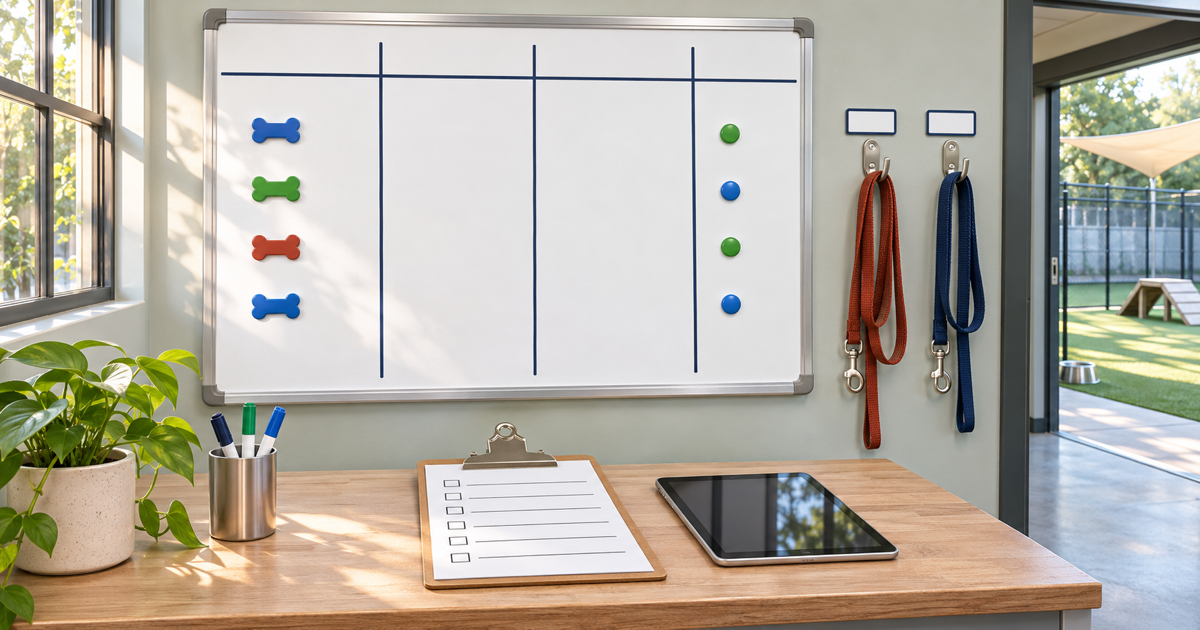
Kennel management is the way a daycare or boarding team keeps each dog's identity, booking, presence, care instructions, completed tasks, incidents and pickup status straight through every shift. Give each fact one home. Update that record when the dog's state changes, then check the live headcount before another person takes over.
The CDC's pet-supply guidance distinguishes cleaning, which physically removes dirt and germs with soap or detergent, from disinfecting, which kills germs with chemicals. Put them on separate checklist lines when both steps apply, so checking off one cannot be mistaken for the other. The CDC page covers pet items, not kennel licensing; follow product labels and your local rules.
For licensed kennel boarding in England, GOV.UK's statutory guidance says required records must be visible and legible, kept for at least 3 years and backed up when stored electronically. Local requirements differ, so check the rules where you operate. Wherever you are, a manager should be able to work out who was present and what staff did.
What does kennel management include?
Kennel management starts with the booking request and ends when the right dog leaves with the right person. Nothing important should disappear between those points. Keep these four stages connected:
| Stage | Record what matters |
|---|---|
| Before arrival | Dog and owner identity, emergency and vet contacts, vaccine dates, behavior, feeding, medication, signed forms and confirmed dates |
| At the door | The dog who arrived, any changed instructions, belongings, assigned run or play group and actual check-in |
| During care | Food and medication given, toileting or exercise, group changes, incidents, observations and staff member with time |
| At handoff or pickup | Tasks still due, owner follow-up, report card, actual checkout and the person taking responsibility next |
Policies tell the team what should happen. The daily record shows what happened for this dog on this date. You need both.
Where should each kennel fact live?
An accurate kennel management system gives every fact one home. Keep the dog's identity, contacts, vaccine dates, feeding plan, medication directions and behavior notes on the dog's record. Today's presence belongs on a live board. Completed care and incidents go in a timestamped log; the owner-facing summary goes in the report card.
Don't copy the same medication direction onto a whiteboard, a text thread and a sticky note. Someone will update one copy and leave two stale. Paper can still work: use one dated sheet for today's status, one permanent dog record for standing instructions and a correction method that leaves the old entry readable.
The current DogDaycareManager features page describes the midday action this way:
Tap Fed or Gave meds, set the play group, log an incident. Each entry keeps who did it and when.
That source passage supports a narrow claim. The product has places to record a care action, group assignment or incident, along with who did it and when. Source code cannot prove that a live kennel followed the procedure, that an email reached an owner or that the product meets a local recordkeeping rule.
How should a kennel team run the day?
A kennel team should update the record as soon as responsibility changes. Don't wait until closing and hope everyone remembers. Here is one dog moving through the sample day on the product's feature page. The dog is illustrative; the time labels and product states come from that page. The staff checks are recommendations for this worked example.
| Time | State change | Staff action | Proof left for the next person |
|---|---|---|---|
| 7:00 | Expected to present | Match dog and owner, review changed instructions, check in and confirm the assigned group or run | Live board shows the dog present |
| 7:01 | Admission check complete | Review vaccine status before group entry and resolve a missing or expired record | Status is visible on the dog's record |
| Midday | Care due to care completed | Record food or medication when given, note the play group and log any incident with staff name and time | Care log shows completed work and open follow-up |
| 5:30 | Present to gone home | Reconcile care, add the pickup note, send or save the report card and check out | Visit history shows the actual departure |
A report card should come from notes staff already made during the day. Turn one specific observation into a short owner update, so nobody has to invent detail at pickup.
What makes a kennel shift handoff accurate?
A kennel shift handoff is accurate when the outgoing employee checks the live headcount before leaving. Walk the building against the board, one dog at a time. For every dog still present, confirm the run or group, care still due, completed food or medication, any incident, pickup contact and owner follow-up.
Put one person's name on every unfinished job. "Medication later" is too vague. "Run 4 medication due at 6:00 p.m.; not given; Casey owns it" gives the receiving employee a dog, time, state and person responsible. The receiving employee repeats it back, then both people look at the saved record. Talking confirms the handoff. The written record is what lasts.
If an evaluation places conditions on group play, store the condition where the check-in staff will see it. The dog daycare temperament test guide includes a copyable assessment with result, group type and re-test date fields that can feed that standing record.
Can I copy a kennel management worksheet?
A kennel management worksheet works when each row shows one dog, the dog's current state, the next due action and proof that the work was done. Use one sheet per date. Don't erase completed actions. Strike through an error once, then initial and time the correction.
| Dog / kennel | Expected | In building | Food or meds due | Completed + staff/time | Incident or follow-up | Checked out |
|---|---|---|---|---|---|---|
At shift change, count the checked-in rows and compare that number with the dogs you can physically account for. Fix any mismatch before either employee leaves. At closing, every row should show checkout or name the overnight employee taking over.
How does software support kennel management?
Kennel management software helps by connecting identity, attendance, care actions and owner communication. Staff should be able to see the current state at the desk, find standing instructions beside the dog and tell who completed each care action.
Software cannot decide your admission policy, verify that a staff member matched the right dog or replace a physical headcount. It also cannot recover an update nobody recorded. Write the procedure first, practice it on paper and use software to cut duplicate entry and keep the saved state visible.
How should I audit kennel management each week?
A weekly kennel management audit compares bookings, check-ins, care logs and checkouts. Pick a completed day and follow every dog from expected through gone home. Confirm that staff physically accounted for each dog marked present, due care has a name and time, incidents have a follow-up owner and every departure has an actual checkout.
Write down why each gap happened. If staff did the work but logged it late, move the record closer to the task. If two places disagreed, remove the duplicate. If nobody owned the follow-up, add a name to the handoff field. Fix the system that allowed the miss instead of telling everyone to "be more careful."
What do operators ask about kennel management?
These kennel management answers cover the practical questions that come up when a small team replaces memory with a repeatable record.
What is the main goal of kennel management?
The main goal of kennel management is to keep each dog's identity, presence, care needs, completed actions and release status accurate from arrival through pickup.
What records should a boarding kennel keep?
A boarding kennel should keep the records required by its local regulator and insurer, plus the operational records its staff need for safe care. Common categories include owner and emergency contacts, arrival and departure, health and behavior history, diet, medication, consent and current vaccination information.
How often should kennel staff update records?
Kennel staff should update a record when the state changes: at check-in, when care is completed, when an incident occurs, at shift handoff and at checkout. Waiting until the end of the day makes the record depend on memory.
Can a small kennel use paper instead of software?
A small kennel can use paper if there is one current version, corrections remain visible, staff can find it at the point of care and completed sheets are stored according to applicable rules. Software becomes useful when duplicate sheets, remote updates or searching old visits create friction.